
The Secret Behind Flamingos’ Pink Feathers
 EnglishMasteryHub
Article Level: A1-A2
Explanation: Discover why flamingos are not born pink and how their food changes the colour of their feathers. Learn what baby flamingos look like, what these beautiful birds eat, and how they slowly develop their famous pink colour as they grow.
Commonly Used Words from the Article
1. Feather /ˈfeðə/ (noun) : One of the soft parts that cover a bird’s body.
The flamingo has beautiful pink feathers.
2. Beak /biːk/ (noun) : The hard, pointed part of a bird’s mouth.
The flamingo uses its beak to find food in the water.
3. Tiny /ˈtaɪni/ (adjective) : Very small.
Flamingos eat tiny animals that live in lakes.
4. Change /tʃeɪndʒ/ (verb) : To become different.
A flamingo’s feathers change colour as it grows.
5. Slowly /ˈsləʊli/ (adverb) : Not quickly.
The baby flamingo slowly becomes pink as it gets older.
Phrasal Verb
-
Grow up /ɡrəʊ ˈʌp/ : To become an adult or grow from a child or young animal into an adult.
Baby flamingos grow up and slowly develop their pink feathers.
Idiom
-
Catch your eye /kætʃ jɔːr aɪ/ : To attract your attention because something looks interesting, beautiful or unusual.
The bright pink flamingos caught my eye when I visited the lake.
Audio File of the Article
Read more: The Secret Behind Flamingos’ Pink Feathers
The Secret Behind Flamingos’ Pink Feathers
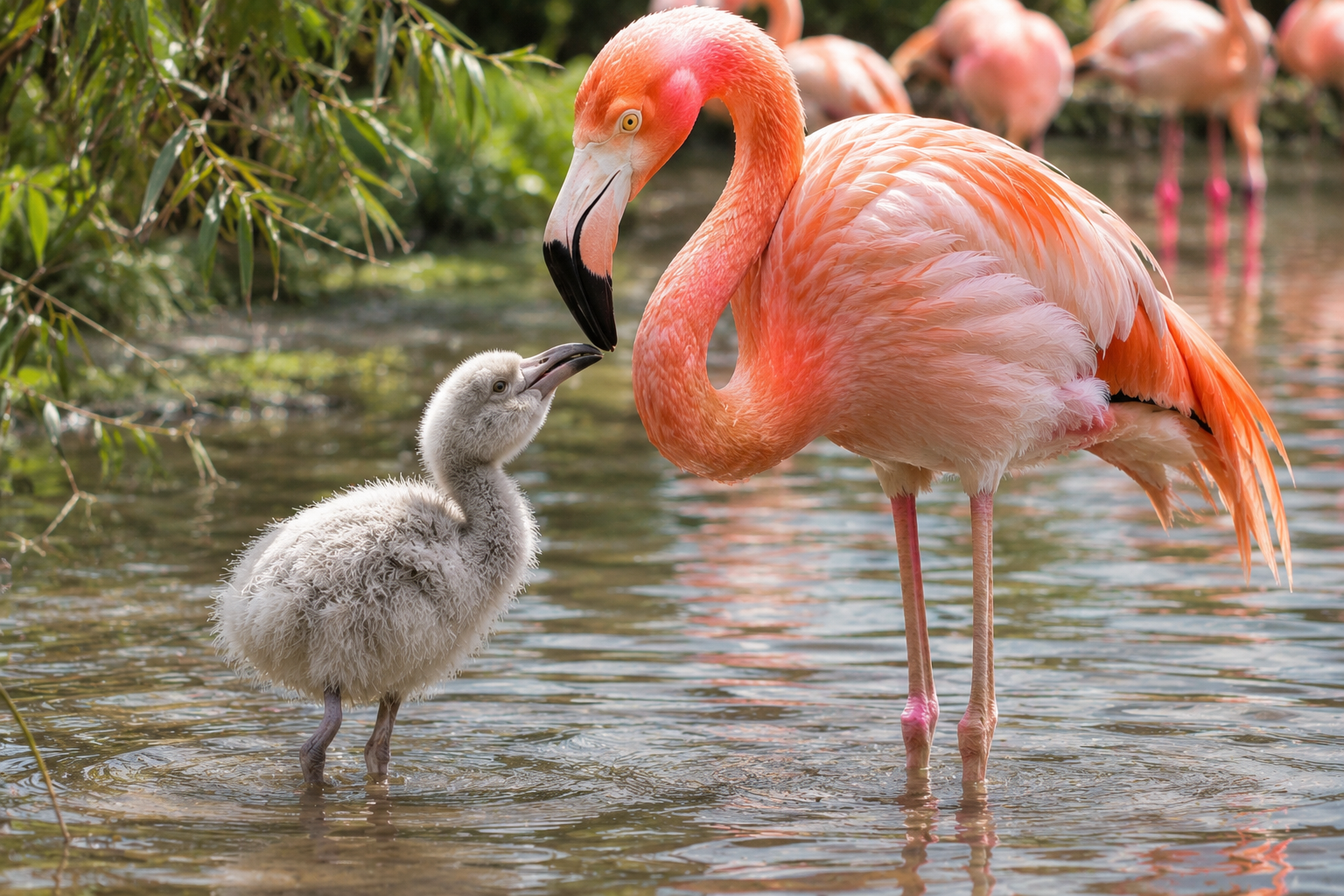
Look at a group of flamingos by a lake. You may see tall birds with long legs, curved necks and lovely pink feathers. They are easy to notice. In fact, their bright colour can catch your eye from far away. But here is a surprise: flamingos are not born pink!
Flamingos often make their homes near lakes. Many live together in big groups. When they stand side by side, the water can look full of pink birds.
When Baby Flamingos Are Born
A baby flamingo usually has soft white or grey feathers. It looks very different from its parents. Its beak is also quite straight at first. As the bird gets older, its beak slowly changes shape.
Imagine you visited a lake last year. You saw a little grey flamingo near its mother. You took a photograph. Today, you visited the same lake again. You saw a pink bird standing near the water. Was it the same bird? Maybe!
The Food Behind Their Colour
The answer is food. Flamingos eat small animals, such as shrimp, and tiny plants called algae. These foods contain natural colours called carotenoids. This is a long word, but the idea is simple. The birds eat food with these colours, and their bodies use them. Over time, the colour appears in their new feathers.
Think of an orange carrot. It has natural colour, too. Flamingos do not eat carrots to turn pink. The food in their lakes gives them the colours they need.
It does not happen after one meal. A young flamingo needs time to grow up. It can take two or three years for the bird to get its adult colour. Some flamingos become light pink. Others have darker pink or orange feathers.
How Do Flamingos Eat?
Flamingos often look for food in shallow water. They put their heads down and use their special beaks to take food from the water. Their beaks help them keep the food and let the water go.
At first, baby flamingos cannot eat in this way. Their parents feed them a special red liquid made in their bodies. Both the mother and the father can do this. Later, the young birds learn to find food for themselves.
Sometimes the feathers of a parent become lighter while it feeds its chick. The parent gives some of its natural colour to the baby through this special food.
Can Flamingos Lose Their Pink Colour?
Yes, their colour can become lighter. If flamingos do not eat enough food with these natural colours, their new feathers may be less pink. This change happens slowly. A bird does not become white in one day.
People sometimes think all flamingos are the same bright pink. That is not true. Their colour can be different because of their food and the type of flamingo. Both shades are beautiful.
A Beautiful Lesson From Nature
Next time you see a flamingo, look at its feathers. Think about the food it eats and the time it takes to change. A grey baby bird can become a beautiful pink adult. Nature has many wonderful surprises, and even a simple bird can teach us something new.

Grammar Notes
Past Simple
We use the Past Simple to talk about actions or events that happened and finished in the past.
Regular Verbs
For many regular verbs, we add -ed to form the Past Simple.
-
Present: visit → Past: visited
-
Present: look → Past: looked
Example from the article:
“Imagine you visited a lake last year.”
Here, visited describes an action in the past.
Irregular Verbs
Some verbs have different Past Simple forms.
-
see → saw
-
take → took
-
be → was/were
Examples from the article:
-
“You saw a little grey flamingo near its mother.”
-
“You took a photograph.”
-
“It was not pink then.”
Past Simple Questions
We often use Did + subject + base verb to ask about the past.
Example:
“Did you see a flamingo yesterday?”
For questions with was or were, we change the word order.
Example from the article:
“Was it the same bird?”
Remember: We often use the Past Simple with time expressions such as yesterday, last week and last year.
Join Our FREE English Grammar Course and improve your grammar skills!
Five Questions Based on the Article
-
What colour are baby flamingos when they are born?
-
What do flamingos eat to help their feathers turn pink?
-
How long can it take for a flamingo to get its adult colour?
-
How do flamingos use their beaks to find food?
-
What can happen if flamingos do not eat enough food with natural colours?
Join Our Weekly English-speaking Class and improve your speaking skills!
We’d love to hear your thoughts! Join the conversation by leaving a comment below. Sharing your insights, questions, or experiences can help you connect with others in our English learning community. It’s a great way to practice your English skills, engage with like-minded individuals, and improve together. Don’t be shy—jump in and let’s keep the discussion going!