
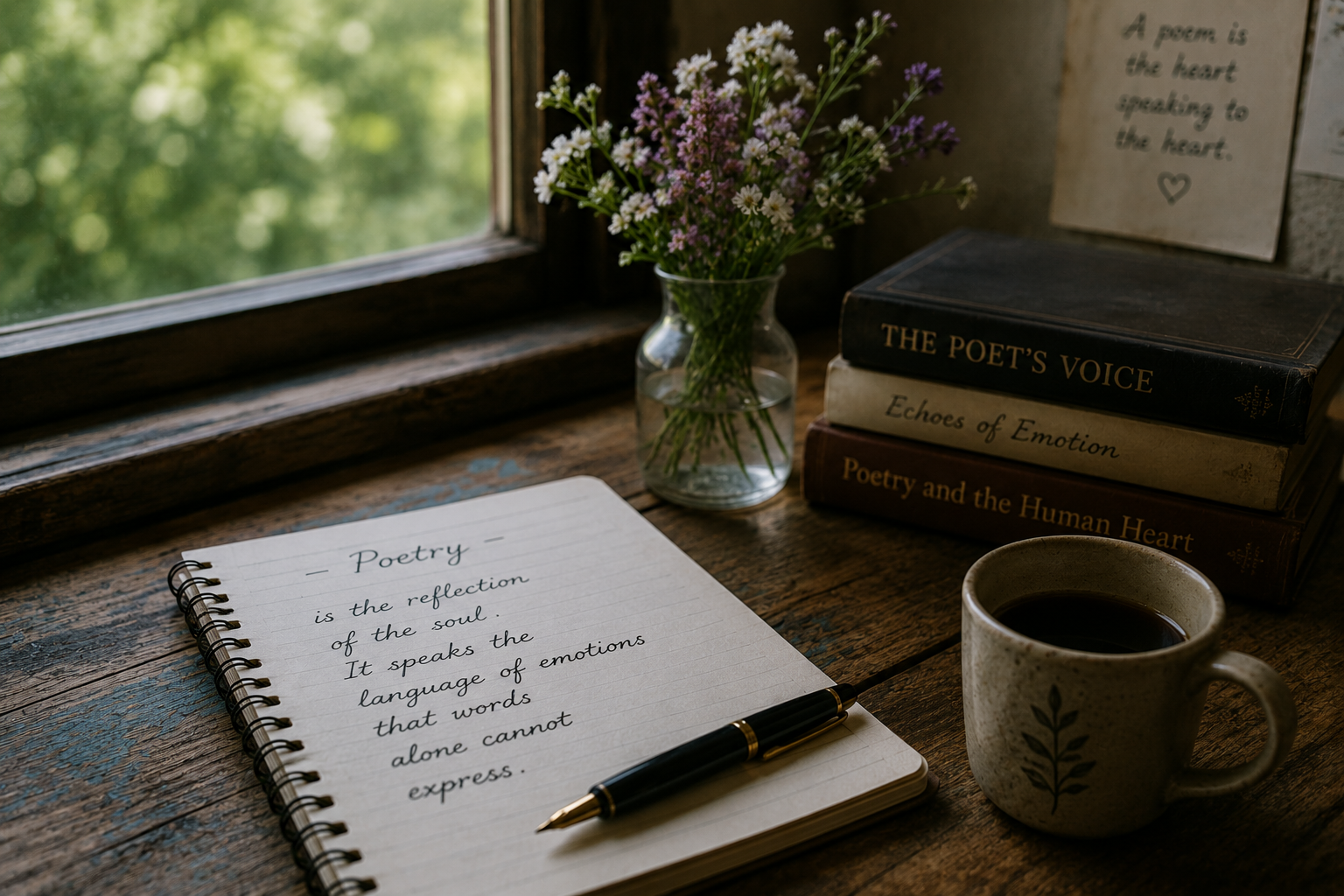
The Reflection of Poets’ Emotions in Their Works
 EnglishMasteryHub
Article Level: C1-C2
Explanation: Poetry has always reflected human emotions through powerful language and artistic expression. This article explores how poets transform personal feelings such as love, loneliness, hope, and sorrow into meaningful literary works that emotionally connect with readers across generations.
Commonly Used Words from the Article
1. Reflection /rɪˈflɛkʃən/ (noun): The expression or representation of something.
The poem is a reflection of the writer’s inner pain.
2. Imagery /ˈɪmɪdʒəri/ (noun): Descriptive language that creates mental pictures.
The poet’s imagery made the scene feel alive.
3. Melancholic /ˌmɛlənˈkɒlɪk/ (adjective): Feeling deep sadness.
The poet used a melancholic tone throughout the poem.
4. Sincerity /sɪnˈsɛrəti/ (noun): Honesty and genuineness.
Readers admired the sincerity of her writing.
5. Authentic /ɔːˈθɛntɪk/ (adjective): Real and genuine.
His poems felt authentic and emotionally powerful.
Phrasal Verb
- Focused on /ˈfəʊkəst ɒn/ : To give attention or importance to something.
The poet focused on themes of loneliness and hope.
Idiom
- Enter their emotional world /ˈɛntə ðeər ɪˈməʊʃənl wɜːld/ : To deeply understand another person’s feelings and thoughts.
Poetry allows readers to enter their emotional world through language and imagery.
Audio File of the Article
Read more: The Reflection of Poets’ Emotions in Their Works

The Reflection of Poets’ Emotions in Their Works
Poetry has always been one of the most powerful forms of artistic expression. Throughout history, poets have used language not only to describe the world around them but also to reveal their deepest emotions. Love, grief, loneliness, hope, and disappointment have all found a place within poetry. As a result, readers often feel emotionally connected to poems, even when they were written centuries ago. Poetry has become a timeless mirror of human emotion because poets have transformed personal experiences into universal messages.
One of the main reasons emotions strongly influence poetry is that poets often write during emotionally intense moments. Many writers have experienced heartbreak, social isolation, or personal loss, and these feelings have shaped their literary works. Rather than hiding their emotions, poets frequently express them through symbolism, imagery, and rhythm. For example, dark weather may symbolise sadness, while natural landscapes may represent peace or freedom. Through these artistic choices, poets allow readers to enter their emotional world.
Moreover, poetry has always provided a safe space for emotional honesty. In ordinary life, people sometimes struggle to communicate their true feelings openly. However, poetry allows emotions to be expressed in a more creative and meaningful way. Some poets have written about political oppression, while others have focused on personal suffering or romantic desire. Their emotional sincerity has helped readers relate to their experiences across different cultures and generations.
Another important aspect is the emotional effect poetry has on readers. A powerful poem can awaken forgotten memories, inspire reflection, or even change someone’s perspective on life. Readers often see parts of themselves within poems because human emotions are deeply shared experiences. As a result, poetry creates an invisible emotional connection between the writer and the audience. This emotional bridge has remained significant even in modern society, where digital communication often feels impersonal.
In addition, the style of a poem is frequently influenced by the poet’s emotional state. A joyful poet may use flowing rhythms and bright imagery, whereas a melancholic poet may prefer slower structures and darker descriptions. These emotional elements shape not only the meaning of the poem but also its atmosphere and tone. Consequently, poetry becomes more than simple language; it becomes an emotional experience.
In conclusion, poets’ emotions play a fundamental role in the creation of poetry. Through their works, poets have shared their fears, dreams, passions, and sorrows with the world. Their emotional honesty continues to influence readers and keeps poetry relevant across generations. Ultimately, poetry remains one of the clearest reflections of the human soul because it captures emotions in their most authentic form.
Grammar Notes
Present Perfect Usage
The article uses the Present Perfect tense to describe actions or experiences connected to the present.
Example from the article:
“Poetry has become a timeless mirror of human emotion.”
Structure:
Subject+has/have+past participle\text{Subject} + \text{has/have} + \text{past participle}
Examples:
- Poets have expressed emotions for centuries.
- Readers have connected with poetry across generations.
Why is Present Perfect used?
The Present Perfect is used:
- for experiences,
- for actions continuing into the present,
- for situations with present importance.
Join Our FREE English Grammar Course and improve your grammar skills!
Five Questions Based on the Article
-
Why has poetry remained emotionally powerful throughout history?
-
How do poets use symbolism to express their emotions?
-
Why does poetry create a connection between readers and writers?
-
In what ways can a poet’s emotional state influence poetic style?
-
Why has poetry continued to remain relevant in modern society?
Join Our Weekly English-speaking Class and improve your speaking skills!
We’d love to hear your thoughts! Join the conversation by leaving a comment below. Sharing your insights, questions, or experiences can help you connect with others in our English learning community. It’s a great way to practice your English skills, engage with like-minded individuals, and improve together. Don’t be shy—jump in and let’s keep the discussion going!