
Why Do Octopuses Have Three Hearts?
 EnglishMasteryHub
Article Level: B1-B2
Explanation: Discover why octopuses have three hearts, how each heart performs a different role, and why their blood is blue. Learn how their unusual circulatory system carries oxygen and helps these fascinating sea animals survive underwater.
Commonly Used Words from the Article
1. Circulatory /ˌsɜːkjəˈleɪtəri/ (adjective) : Related to the movement of blood around the body.
The heart is an important part of the circulatory system.
2. Efficiently /ɪˈfɪʃəntli/ (adverb) : In a way that works well without wasting energy or time.
The octopus’s hearts help move blood efficiently around its body.
3. Demanding /dɪˈmɑːndɪŋ/ (adjective) : Requiring a lot of effort, energy or skill.
Swimming can be physically demanding for an octopus.
4. Adaptation /ˌædæpˈteɪʃən/ (noun) : A feature or change that helps a living thing survive in its environment.
Having three hearts is an important adaptation to underwater life.
5. Transport /ˈtrænspɔːt/ (verb) : To carry or move something from one place to another.
Blood transports oxygen around the body.
Phrasal Verb
- Rely on /rɪˈlaɪ ɒn/ : To need or depend on someone or something in order to function or succeed.
Octopuses rely on their specialised circulatory system to carry oxygen around their bodies.
Idiom
-
A matter of life and death /ə ˌmætər əv ˌlaɪf ən ˈdɛθ/ : A situation that is extremely important because survival may depend on it.
For many marine animals, getting enough oxygen can be a matter of life and death.
Audio File of the Article
Read more: Why Do Octopuses Have Three Hearts?

Why Do Octopuses Have Three Hearts?
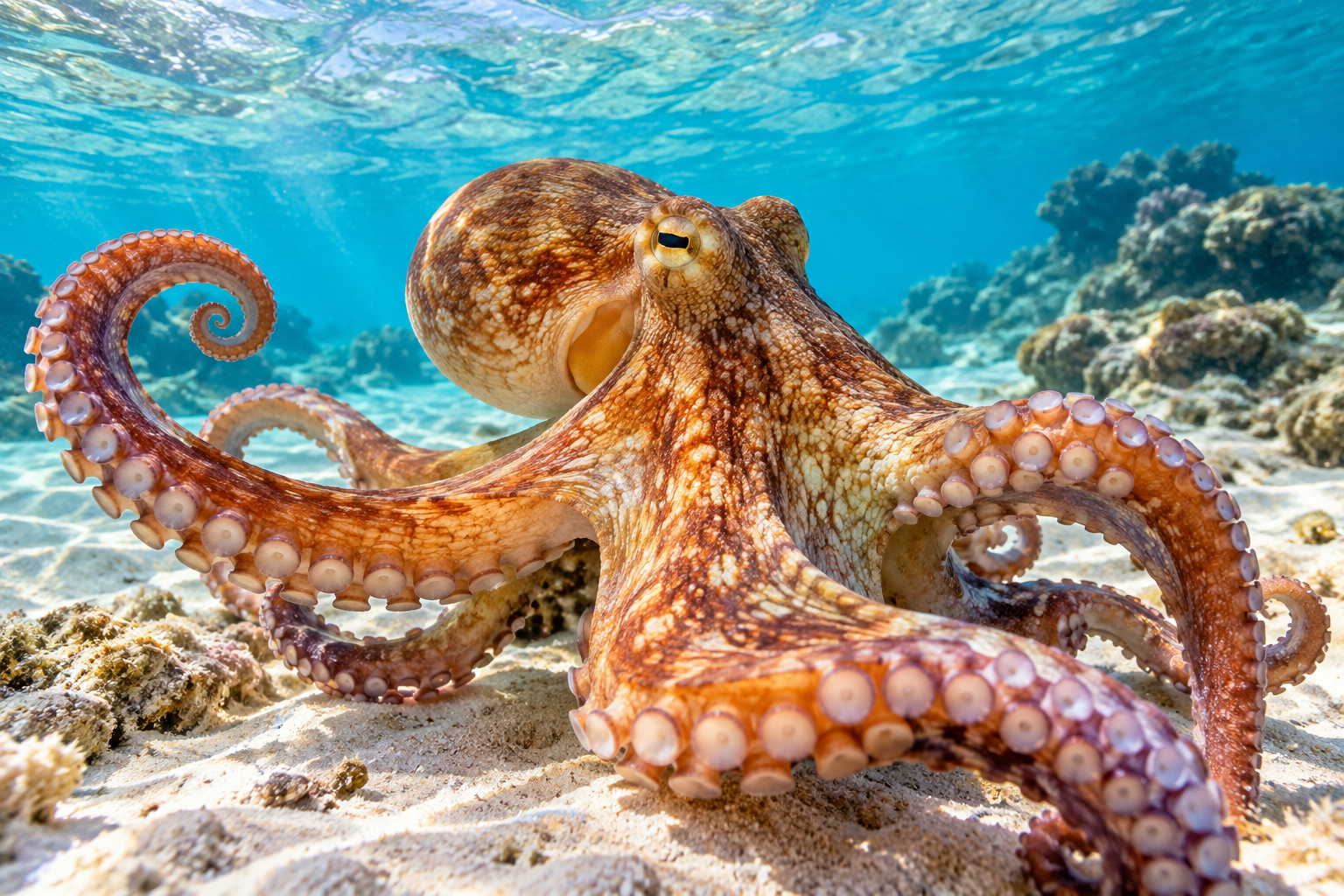
Octopuses are some of the most unusual animals in the ocean. They have eight arms, excellent eyesight, impressive problem-solving skills and the ability to change the colour and texture of their skin. However, one of their most surprising features is hidden inside their bodies: an octopus has three hearts. But why does it need so many?
The answer is closely connected to the octopus’s circulatory system. Two of its hearts are called branchial hearts. These hearts pump blood through the gills, where the blood collects oxygen from the water. The third heart, known as the systemic heart, then pumps this oxygen-rich blood around the rest of the body. In simple terms, two hearts help with breathing, while the third supplies the organs and muscles with oxygen.
There is another interesting difference between octopuses and humans. Human blood is red because it contains haemoglobin, an iron-rich protein that carries oxygen. Octopus blood, however, appears blue because it uses a copper-containing protein called haemocyanin instead. Haemocyanin works particularly well in cold water and helps transport oxygen around the octopus’s body.
Swimming creates an unusual challenge for these animals. When an octopus swims, its systemic heart may temporarily stop beating. This makes swimming physically demanding. As a result, octopuses often prefer crawling along the seabed using their arms. Crawling requires less energy and allows their circulatory system to operate more efficiently.
Octopuses rely on their specialised circulatory system to carry oxygen around their bodies. Each of their three hearts has a specific role, and together they keep oxygen moving through the animal. For many marine animals, getting enough oxygen can be a matter of life and death. The octopus’s unusual three-heart system therefore plays an essential role in its survival.
Scientists have studied these fascinating animals for many years, but there is still plenty to discover. By the end of the next decade, researchers will have been studying octopus behaviour and biology for many more years. Marine biologists will have been examining how changes in water temperature and oxygen levels affect octopuses over long periods. This research may help us understand how these animals respond to changing ocean conditions.
By the time future generations of scientists make new discoveries, researchers will have been collecting information about octopuses for decades. Their work could reveal even more about how the animals’ unusual bodies function and how they have adapted to different environments.
Three hearts may sound excessive to humans, but each one performs an essential job. Two send blood towards the gills, while the third sends oxygen-rich blood throughout the body. Together, they support one of the ocean’s most remarkable animals. Behind those eight arms and curious behaviour is an extraordinary three-heart system working constantly to keep the octopus alive.
Grammar Notes
Future Perfect Continuous Tense
The Future Perfect Continuous Tense is formed with:
will + have + been + verb-ing
We use it to describe an action that will continue over a period of time up to a particular point in the future. It often emphasises how long an activity will have been happening.
Examples from the article:
- Researchers will have been studying octopus behaviour and biology for many more years.
- Marine biologists will have been examining how changing ocean conditions affect octopuses.
- Researchers will have been collecting information about octopuses for decades.
Structure:
Positive: Subject + will have been + verb-ing
Scientists will have been studying octopuses for many years.
Negative: Subject + will not have been + verb-ing
Scientists will not have been studying this species for very long.
Question: Will + subject + have been + verb-ing?
Will scientists have been studying octopuses for several decades?
Common time expressions:
The Future Perfect Continuous is often used with expressions such as for five years, for decades, by next year, by the end of the decade and by the time.
Join Our FREE English Grammar Course and improve your grammar skills!
Five Questions Based on the Article
-
What is the main job of the two branchial hearts?
- What does the systemic heart do?
-
Why does octopus blood appear blue?
-
Why do octopuses often prefer crawling along the seabed to swimming?
-
What will scientists have been studying to understand octopuses better?
Join Our Weekly English-speaking Class and improve your speaking skills!
We’d love to hear your thoughts! Join the conversation by leaving a comment below. Sharing your insights, questions, or experiences can help you connect with others in our English learning community. It’s a great way to practice your English skills, engage with like-minded individuals, and improve together. Don’t be shy—jump in and let’s keep the discussion going!