
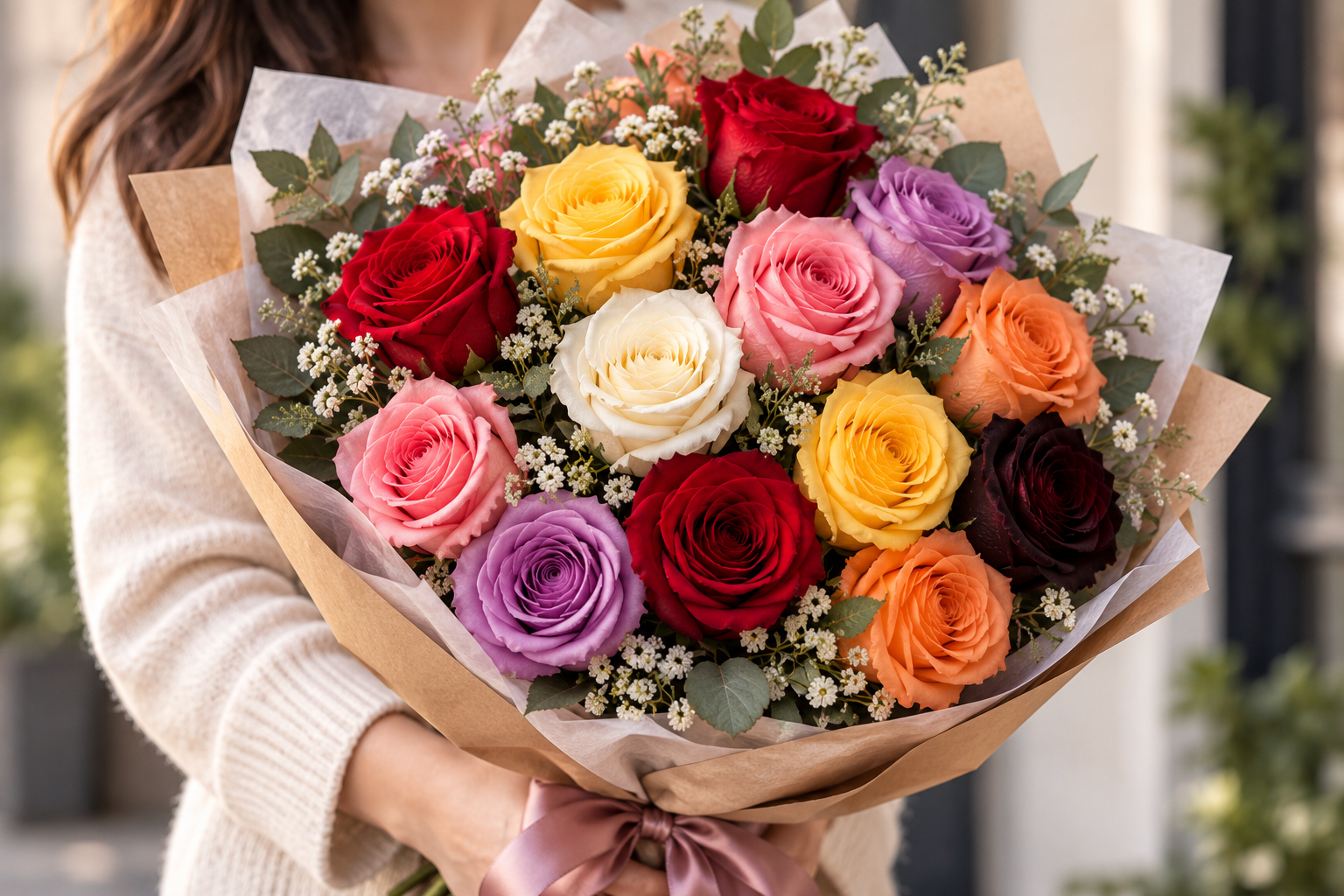
Beyond Red Roses: The Surprising Meanings Behind Every Rose Colour
 EnglishMasteryHub
Article Level: C1-C2
Explanation: Discover the hidden language of roses and explore how their colours have carried surprising meanings throughout history. From jealousy and admiration to mystery and transformation, learn why rose symbolism is far more complex than it seems.
Commonly Used Words from the Article
1. Convey /kənˈveɪ/ (verb): To communicate or express an idea, feeling or message.
A carefully chosen flower can convey a message without words.
2. Intriguing /ɪnˈtriːɡɪŋ/ (adjective): Very interesting because something is unusual or mysterious.
The history behind the white rose is surprisingly intriguing.
3. Elusive /iˈluːsɪv/ (adjective): Difficult to find, achieve or obtain.
For generations, a naturally blue rose remained elusive.
4. Unattainable /ˌʌnəˈteɪnəbəl/ (adjective): Impossible or extremely difficult to achieve or obtain.
In literature, the distant island represented an unattainable dream.
5. Nuanced /ˈnjuːɑːnst/ (adjective): Showing subtle differences or distinctions in meaning.
Historical symbols often have more nuanced meanings than modern interpretations suggest.
Phrasal Verb
- Stem from /stem frəm/ : To be caused by or originate from something.
Many traditional beliefs about rose colours stem from customs that developed centuries ago.
Idiom
- Catch someone off guard /kætʃ ˈsʌmwʌn ɒf ɡɑːd/ : To surprise someone when they are not expecting something.
The unexpected meaning of the yellow rose caught me off guard.
Audio File of the Article
Read more: Beyond Red Roses: The Surprising Meanings Behind Every Rose Colour

Beyond Red Roses: The Surprising Meanings Behind Every Rose Colour
Ask someone what a red rose means and the answer will probably be love. Yet the language of roses is far more complicated than the familiar bouquets exchanged on Valentine’s Day. For centuries, colour has transformed the rose into a remarkably flexible symbol, capable of expressing everything from jealousy to mystery.
This became particularly fascinating during the Victorian era, when floriography — the language of flowers — was fashionable. People were consulting floral dictionaries while choosing bouquets, allowing flowers to communicate feelings that social conventions sometimes made difficult to express openly. However, these dictionaries did not always agree. A flower could acquire different meanings depending on the source, period or context. In other words, floral symbolism was never quite as fixed as we sometimes imagine.
Take the yellow rose. Today, it is frequently associated with friendship, warmth and happiness. Historically, however, yellow roses could convey something considerably less cheerful: jealousy. This contrast illustrates how dramatically symbolism can change. A bouquet that seems friendly to a modern recipient might once have suggested suspicion or emotional unease.
White roses have an equally intriguing history. Purity and innocence are their most familiar associations today, particularly in ceremonial settings. Yet nineteenth-century flower guides assigned them more specific and sometimes contradictory messages. In one Victorian source, a white rose could express a desire to remain single; another interpreted it as a declaration of worthiness. Even apparently simple colours were therefore open to interpretation.
Pink roses generally occupy gentler territory, conveying admiration, appreciation and affection without the intensity traditionally attached to red. Orange roses, meanwhile, are commonly associated with enthusiasm, fascination and desire. Their fiery appearance places them somewhere between the warmth of yellow and the passion of red, making them particularly expressive when admiration has begun to develop into something stronger.
Then there are colours whose meanings stem from their rarity as much as their appearance. Lavender and purple roses have become associated with enchantment, fascination and a sense of the extraordinary. Blue roses go even further. Because a naturally true-blue rose has long been elusive, the blue rose has come to evoke mystery, impossibility and the unattainable. Rather than simply communicating affection, it can represent something desired precisely because it seems beyond reach.
Even the so-called black rose complicates the picture. Roses marketed as black are usually extremely dark shades of red or purple rather than genuinely black. Unsurprisingly, they can suggest endings, mourning or farewell, but modern interpretations may also associate them with transformation and new beginnings: one chapter closes so that another can begin.
Rose colours, then, are not a universal code with one permanent translation. Their meanings have been shifting across generations, cultures and contexts. If you assumed every bouquet could be decoded with a simple colour chart, some of these lesser-known meanings might catch you off guard. Sometimes the most familiar flowers are the ones hiding the most unexpected stories.
Grammar Notes
Past Continuous
The Past Continuous is formed with was/were + verb-ing. It describes an action or situation that was in progress at a particular time in the past.
Example from the article:
“People were consulting floral dictionaries while choosing bouquets.”
Here, were consulting describes an activity that was taking place during the Victorian era rather than a single completed action.
Structure:
Subject + was/were + verb-ing
- I/he/she/it was reading
- we/you/they were reading
The Past Continuous is particularly useful when describing historical backgrounds, simultaneous past activities or an action that was already in progress when another event occurred.
Example: People were exchanging coded bouquets while floral dictionaries were becoming increasingly fashionable.
Join Our FREE English Grammar Course and improve your grammar skills!
Five Questions Based on the Article
-
Why was floriography particularly useful within Victorian social conventions?
-
How does the historical meaning of the yellow rose contrast with its common modern interpretation?
-
Why is it misleading to assume that white roses had one fixed meaning in the nineteenth century?
-
How has the rarity of certain rose colours influenced their symbolic meanings?
-
What does the article suggest about the reliability of using a simple colour chart to interpret roses?
Join Our Weekly English-speaking Class and improve your speaking skills!
We’d love to hear your thoughts! Join the conversation by leaving a comment below. Sharing your insights, questions, or experiences can help you connect with others in our English learning community. It’s a great way to practice your English skills, engage with like-minded individuals, and improve together. Don’t be shy—jump in and let’s keep the discussion going!